


Supreme Court Reverses Conviction Solely Based on Uncorroborated Dying Declaration
 Copy Link
 Share
 Save
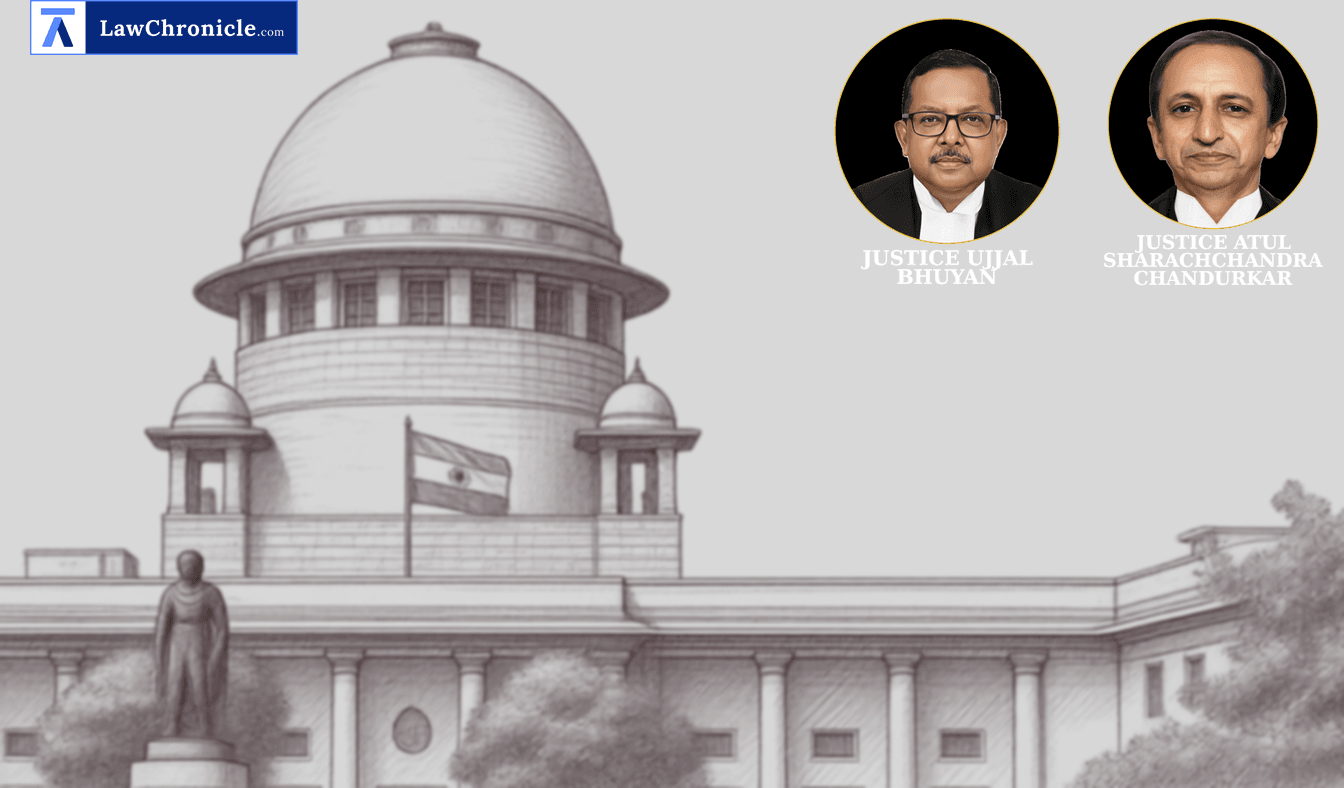
The Supreme Court has ruled that a sole, uncorroborated dying declaration cannot form the foundation for a murder conviction when stark inconsistencies pervade multiple deathbed statements. Reaffirming the sanctity of trial court acquittals, the Apex Court held that Section 106 of the Indian Evidence Act, 1872 cannot be weaponized to bypass the prosecution's primary burden of establishing guilt beyond reasonable doubt.
A bench of Justice Ujjal Bhuyan and Justice Atul S. Chandurkar overturned the Bombay High Court's order that had reversed a trial court acquittal, restoring the trial court's order to set the appellant free.
Key Takeaways
- Uncorroborated Dying Declarations Unsafe: Contradictory deathbed statements cannot sustain a conviction without independent corroborating evidence.
- Limits on Section 106 Burden Shifting: Section 106 of the Indian Evidence Act, 1872 cannot bridge gaps in the prosecution's initial burden to prove its case.
- Prejudice from Unframed Charges: Convicting an accused solely under Section 302 of the Indian Penal Code, 1860 when only a joint liability charge under Section 34 was framed is legally impermissible if co-accused are acquitted.
- Presumption of Innocence Doubled: An acquittal by a trial court strengthens the presumption of innocence, requiring exceptionally strong grounds for an appellate court to interfere.
Court Observations and Directions
The Apex Court scrutinized the High Court's selective reliance on one dying declaration while disregarding two others that implicated other family members. Emphasizing the necessity of corroboration in the presence of conflicting statements, the Supreme Court noted that the failure to examine crucial witnesses, such as the individual who rescued the victim and brought her to the hospital, proved fatal to the prosecution's case. The Bench highlighted that “Section 106 of the Evidence Act cannot be invoked to make up the inability of the prosecution to produce evidence of circumstances pointing to the guilt of the accused. This section cannot be used to support a conviction unless the prosecution has discharged the onus by proving all the elements necessary to establish the offence. It does not absolve the prosecution from the duty of proving that a crime was committed even though it is a matter specifically within the knowledge of the accused and it does not throw the burden on the accused to show that no crime was committed.”
Ratio
Where multiple dying declarations are inconsistent with one another, an uncorroborated declaration cannot form the sole basis to overturn a trial court acquittal. Furthermore, when all co-accused are acquitted of a joint charge under Section 302 read with Section 34 of the Indian Penal Code, 1860, a single accused cannot be convicted for the substantive offence under Section 302 without a distinct, independent charge framed against them, as doing so causes severe prejudice.
Background
The case stems from an incident on April 10, 2005, where the victim suffered 90% burn injuries and subsequently succumbed to septicemia. The prosecution alleged that the appellant, along with her husband, son, and younger son, harassed the victim for dowry and eventually set her ablaze in furtherance of their common intention. A joint charge was framed against all four accused under Sections 498A, 342, 406, and 302 read with Section 34 of the Indian Penal Code, 1860.
The Sessions Court acquitted all the accused, highlighting major contradictions across three dying declarations and noting that the prosecution failed to examine Vishwas Patil, the first responder who extinguished the fire and hospitalized the deceased. On appeal, the High Court reversed the acquittal for the appellant alone, holding her guilty under Section 302 of the Indian Penal Code, 1860 based on one dying declaration and the fact that she was present in the house, invoking Section 106 of the Indian Evidence Act, 1872.
Analyzing the statutory framework and precedent, the Supreme Court held that the High Court erred in creating a new case against the appellant in the absence of an independent charge under Section 302. Relying on rulings in Krishna Govind Patil Vs. State of Maharashtra, Jagbir Singh Vs. State (N.C.T. of Delhi) ( "2019 INSC 1000": 2019 CaseBase(SC) 332), and Abhishek Sharma Vs. State (Govt. of NCT of Delhi) ( "2023 INSC 924": 2023 CaseBase(SC) 801), the bench observed that common intention requires prior concert, and acquitting three co-accused negates joint liability under Section 34. Referring to principles reaffirmed in Anees Vs. The State Govt. of NCT ( "2024 INSC 368": 2024 CaseBase(SC) 42), the Supreme Court restored the Sessions Court's judgment of acquittal under the Code Of Criminal Procedure, 1973.
Case Details:
Case No.: Criminal Appeal No. 118 of 2018
Neutral Citation: 2026 INSC 1196
Case Title: Sau. Kamalbai Waman Patil v. The State of Maharashtra
Source: 2026 CaseBase(SC) 9530
Similar Articles
 Breaking News


