

SC: Word ‘Can’ in Arbitration Clause Doesn’t Mandate Arbitration
 Copy Link
 Share
Share Save
Save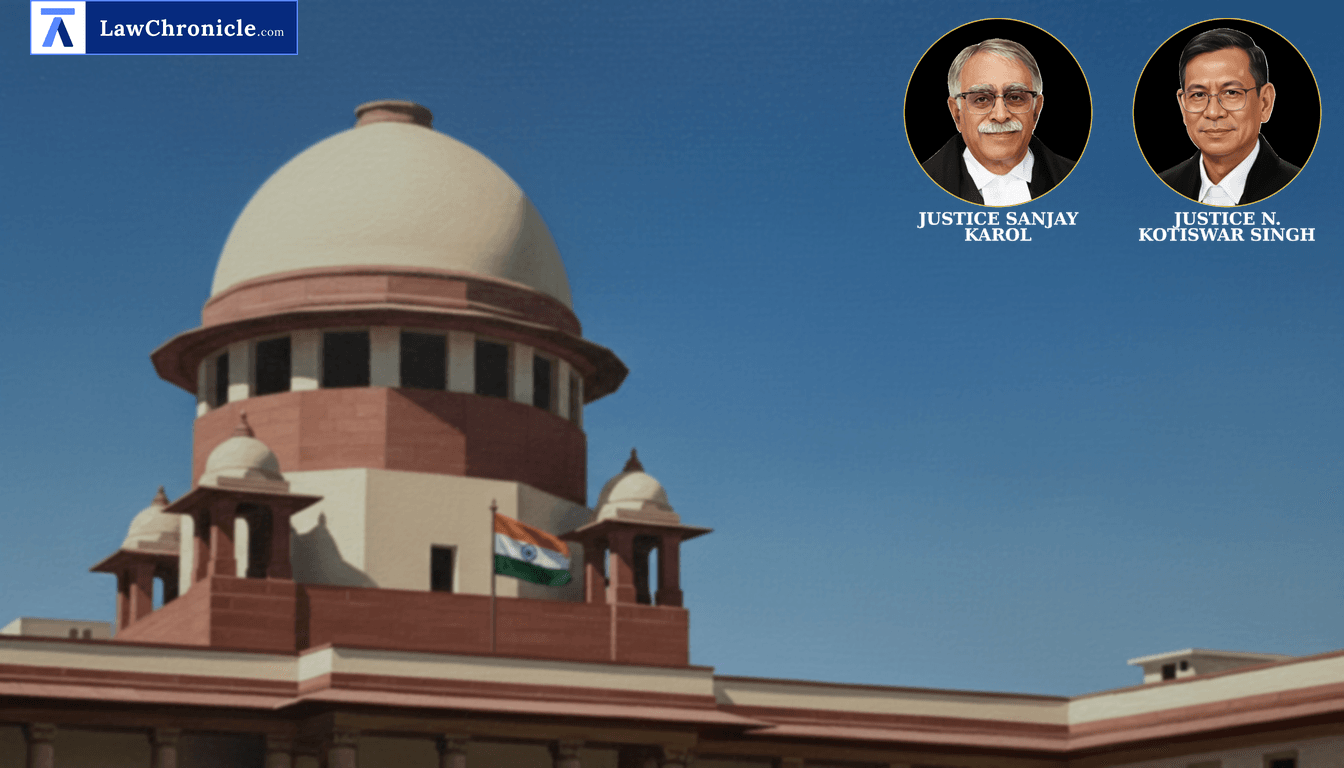
A bench of Justice Sanjay Karol and Justice Nongmeikapam Kotiswar Singh heard an appeal concerning whether the use of the word 'can' in an arbitration clause required mandatory reference of disputes to arbitration or left the parties free to pursue other remedies in the civil courts.
The Court held that the clause in question did not constitute a binding arbitration agreement and dismissed the appeal. The judgment explained that party autonomy and mutual consent were the source of an arbitral tribunal's jurisdiction and that a clause which only contemplated the possibility of arbitration could not be read as mandating arbitration without further agreement.
The Court, in its reasoning, observed: "Turning to the words used in Clause 25, we find it to stipulate to the effect that if there is any dispute between the parties, they can settle the same by arbitration. In view of Jagdish Chander v. Ramesh Chander ( "2007 (5) SCC 719": 2007 CaseBase(SC) 946) (supra) which holds as under: '... Such clauses merely indicate a desire or hope to have the disputes settled by arbitration, or a tentative arrangement to explore arbitration as a mode of settlement if and when a dispute arises. Such clauses require the parties to arrive at a further agreement to go to arbitration, as and when the disputes arise. Any agreement or clause in an agreement requiring or contemplating a further consent or consensus before a reference to arbitration, is not an arbitration agreement, but an agreement to enter into an arbitration agreement in future.' The clause subject matter of dispute in this appeal indicates merely the future possibility of referring disputes to arbitration and as such, it cannot be said to be a binding arbitration agreement."
Background
The dispute arose from carriage of goods under bills of lading issued by the respondent for a consignment to South Carolina, USA, where four of six containers were delivered without dispute but delivery of the fifth container led to non-payment to the appellant. The bills of lading contained Clause 25 under the heading "Arbitration" which provided that "Any difference of opinion or dispute thereunder can be settled by arbitration in India or a place mutually agreed with each party appointing an arbitrator." The appellant invoked arbitration by notice and sought appointment of a sole arbitrator through Arbitration Application No.168 of 2022 before the High Court of Judicature at Bombay; the Single Judge dismissed the application holding that, given the use of the word 'can', there was no mandatory agreement to refer disputes to arbitration.
On appeal the appellant relied on the contention that Section 7 of the Arbitration And Conciliation Act, 1996 did not prescribe any particular form for an arbitration agreement and that prior decisions required a pragmatic approach to interpretation. The bench considered precedents and principles relied upon by the parties: it noted that the Court drew on K.K. Modi v. K.N. Modi ( "1998 (3) SCC 573": 1998 CaseBase(SC) 571) to set out attributes that must be present in an arbitration agreement, applied the test in Jagdish Chander v. Ramesh Chander ( "2007 (5) SCC 719": 2007 CaseBase(SC) 946) to hold that words conveying only possibility did not create a binding obligation to arbitrate, and referred to the concurring observation in Cox & Kings Ltd. v. SAP India (P) Ltd. ( "(2024) 4 SCC 1": 2022 CaseBase(SC) 870) stressing that consent was the source of the tribunal's jurisdiction. The Court also invoked established principles of contractual interpretation from authorities including Union of India v. Raman Iron Foundry ( "(1974) 2 SCC 231": 1974 CaseBase(SC) 278) and Provash Chandra Dalui v. Biswanath Banerjee ( "1989 Supp (1) SCC 487": 1989 CaseBase(SC) 682) to emphasize that the words chosen by the parties expressed their intent and could not be supplemented to impose an obligation not manifested by the contract.
The Court explained that at the stage of appointment under Section 11 of the Arbitration And Conciliation Act, 1996 a prima facie scrutiny of existence of an arbitration agreement was required and that where a clause merely left arbitration as a possibility, further consensus would be necessary before arbitration could be compelled. The appeal was dismissed and any pending applications were disposed of. No interim directions were issued and the parties were left free to pursue other remedies in the absence of mutual agreement to arbitrate.
Case Details:
NeutralCitation: 2026 INSC 384
Case Title: NAGREEKA INDCON PRODUCTS PVT. LTD. v. CARGOCARE LOGISTICS (INDIA) PVT. LTD.
Source: 2026 CaseBase(SC) 337
 Breaking News