

SC: Resolution Plan Approval Extinguishes All Sub-Judice Operational Debt Claims
 Copy Link
 Share
Share Save
Save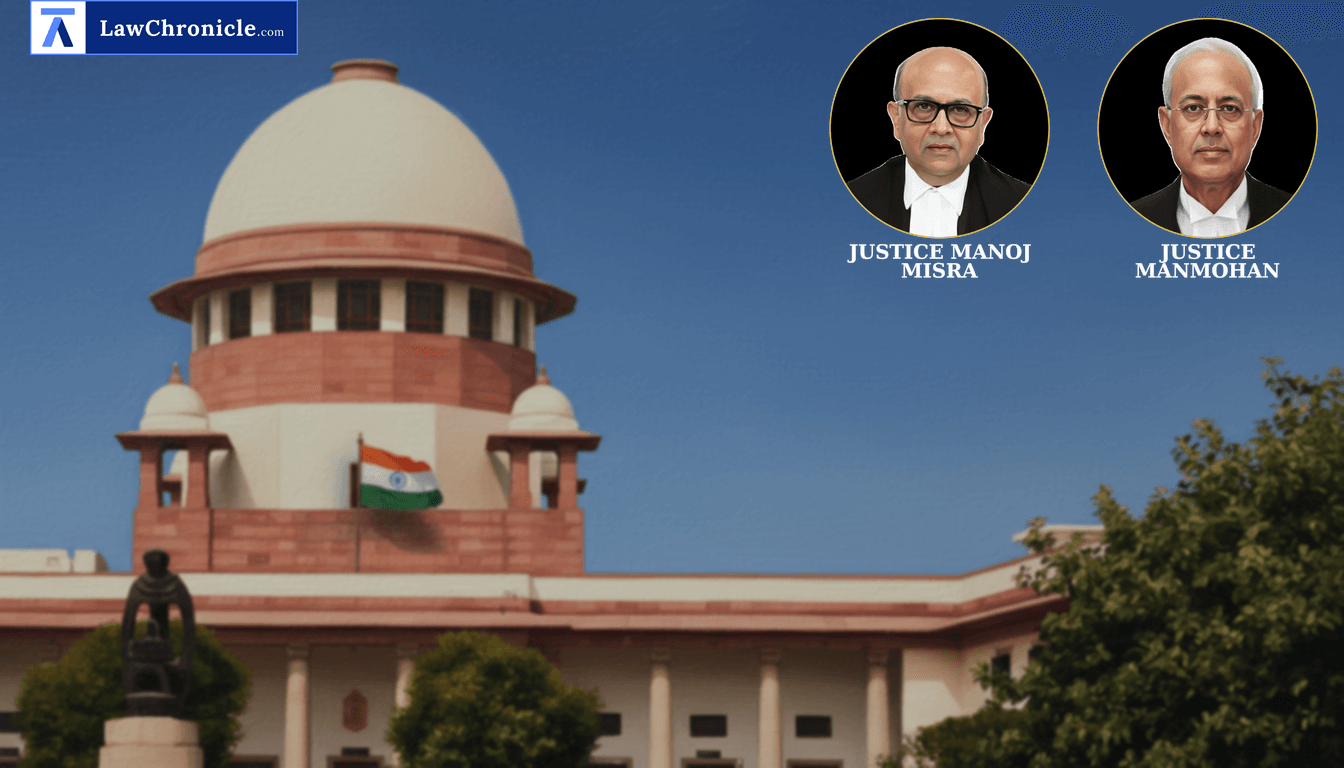
The Supreme Court has fortified the 'clean slate' doctrine by ruling that once a resolution plan is approved, all sub-judice operational claims that were not crystallised into determined amounts by the approval date stand irrevocably extinguished. This landmark decision bars operational creditors from pursuing pending civil suits or arbitrations to recover past dues, ensuring successful resolution applicants take over corporate debtors free from the 'hydra-headed' popping up of undecided liabilities.
In a verdict delivered by a bench comprising Justice Manoj Misra and Justice Manmohan, the Court addressed a significant appeal filed by a Successful Resolution Applicant (SRA) challenging High Court orders that had permitted a recovery suit to proceed despite the sanctioning of a Resolution Plan under the Insolvency and Bankruptcy Code, 2016.
The Finality of the Resolution Plan and Admitted Claims
Justice Manmohan, writing for the bench, emphasized that the treatment of creditors is strictly governed by the Resolution Plan approved by the Committee of Creditors (CoC), whose commercial wisdom remains non-justiciable. The Court noted that in the present case, the claims of the operational creditors were admitted at a notional value of Rupee One (₹1) due to pending disputes. Once the Resolution Plan was approved by the National Company Law Tribunal (NCLT) under Section 31 of the Insolvency and Bankruptcy Code, 2016, these claims were frozen.
The Court, in its reasoning, observed: "A successful resolution applicant cannot suddenly be faced with “undecided” claims after the resolution plan submitted by him has been accepted as this would amount to a hydra head popping up which would throw into uncertainty amounts payable by a prospective resolution applicant who would successfully take over the business of the corporate debtor. All claims must be submitted to and decided by the resolution professional so that a prospective resolution applicant knows exactly what has to be paid... This the successful resolution applicant does on a fresh slate."
Rejection of 'Face Value' Reservation and Fraud Allegations
The bench rejected the argument that surplus funds from the resolution settlement should be ring-fenced for sub-judice claims. It further clarified that allegations of fraud in the resolution process cannot be entertained in a collateral proceeding without filing an application under Rule 11 of the NCLT Rules. The Court held that permitting indeterminate claims to linger indefinitely would undermine the 'fresh start' principles fundamental to the insolvency regime.
Following its detailed analysis, The Court has the following directions:
"...the present Civil Appeals are allowed and the impugned Judgment and Orders passed by the Bombay High Court and Order dated 25th October 2018 passed in Regular Civil Suit No. 153/2011 are set aside. Further, the Suit for recovery filed by Respondent No.1-Varsha (Civil Suit No. 153/2011) pending before 13th Joint Civil Judge, Senior Division, Nagpur as well as arbitration proceedings initiated by Intervenor-Masyc are dismissed."
Key Takeaways:
Absolute Finality of Admitted Claims
Claims not quantified and included in the resolution plan by the date of NCLT approval are permanently extinguished, regardless of pending litigation.
Hydra-Head Protection for SRAs
Successful Resolution Applicants are legally protected from 'surprise' liabilities arising from pre-CIRP disputes once the 'fresh slate' is established.
Commercial Wisdom Precedence
Courts cannot exercise equity to alter the repayment waterfall or settlement corpus decided by the CoC's commercial wisdom.
Legislative Call for MSME Protection
In a significant afterword, the Court highlighted that the Insolvency and Bankruptcy Code, 2016 may need legislative amendments to better protect MSMEs who are currently disenfranchised at the bottom of the repayment waterfall.
Ratio Decidendi:
Upon the approval of a Resolution Plan under Section 31(1) of the Insolvency and Bankruptcy Code, 2016, all claims not crystallised or incorporated in the Plan, including sub-judice claims pending before civil courts or arbitral tribunals, stand abated and extinguished by operation of law. A Successful Resolution Applicant is entitled to a 'clean slate', and any interpretation allowing indeterminate claims to survive beyond the plan's implementation timeline is antithetical to the Code’s objective of corporate revival.
Background:
The dispute arose after the SRA, M/S Tata Steel Ltd., took over Bhushan Steel Limited through a CIRP. Prior to the insolvency, Respondent No. 1 had filed a recovery suit, and another intervenor had initiated arbitration. During the CIRP, the Resolution Professional admitted these disputed claims at a notional value of ₹1. The SRA’s plan provided a settlement corpus for operational creditors but stipulated that sub-judice claims would only be paid to the extent of their admitted (₹1) value. The creditors argued that their proceedings should continue to determine the actual debt. Relying on Committee of Creditors of Essar Steel India Limited v. Satish Kumar Gupta and Others ( "(2020) 8 SCC 531": 2019 CaseBase(SC) 1428) and Ghanashyam Mishra & Sons Pvt. Ltd. vs. Edelweiss Asset Reconstruction Co. Ltd. ( "(2021) 9 SCC 657": 2021 CaseBase(SC) 355), the Supreme Court held that allowing such suits would frustrate the resolution process. The Court also discussed the principles laid down in K. Sashidhar vs. Indian Overseas Bank and Ors. ( "(2019) 12 SCC 150": 2019 CaseBase(SC) 3250) and Swiss Ribbons Private Limited and Anr. v. Union of India & Ors. ( "2019 (4) SCC 17": 2019 CaseBase(SC) 1223) regarding the waterfall mechanism and the status of operational creditors.
Case Details:
Case No.: CIVIL APPEAL Nos. 9052-9053 OF 2026
NeutralCitation: 2026 INSC 717
Case Title: M/S Tata Steel Ltd. Versus Varsha & Anr.
Appearances:
For the Petitioner(s): Mr. Ramji Srinivasan, Senior Advocate
For the Respondent(s): Mr. Garvesh Kabra, Advocate; Mr. Neeraj Kishan Kaul, Senior Advocate
Source: 2026 CaseBase(SC) 668
 Breaking News