


Recovery of Stolen Articles essential for Robbery Charge: SC Convicts for Grievous Hurt
 Copy Link
 Share
 Save
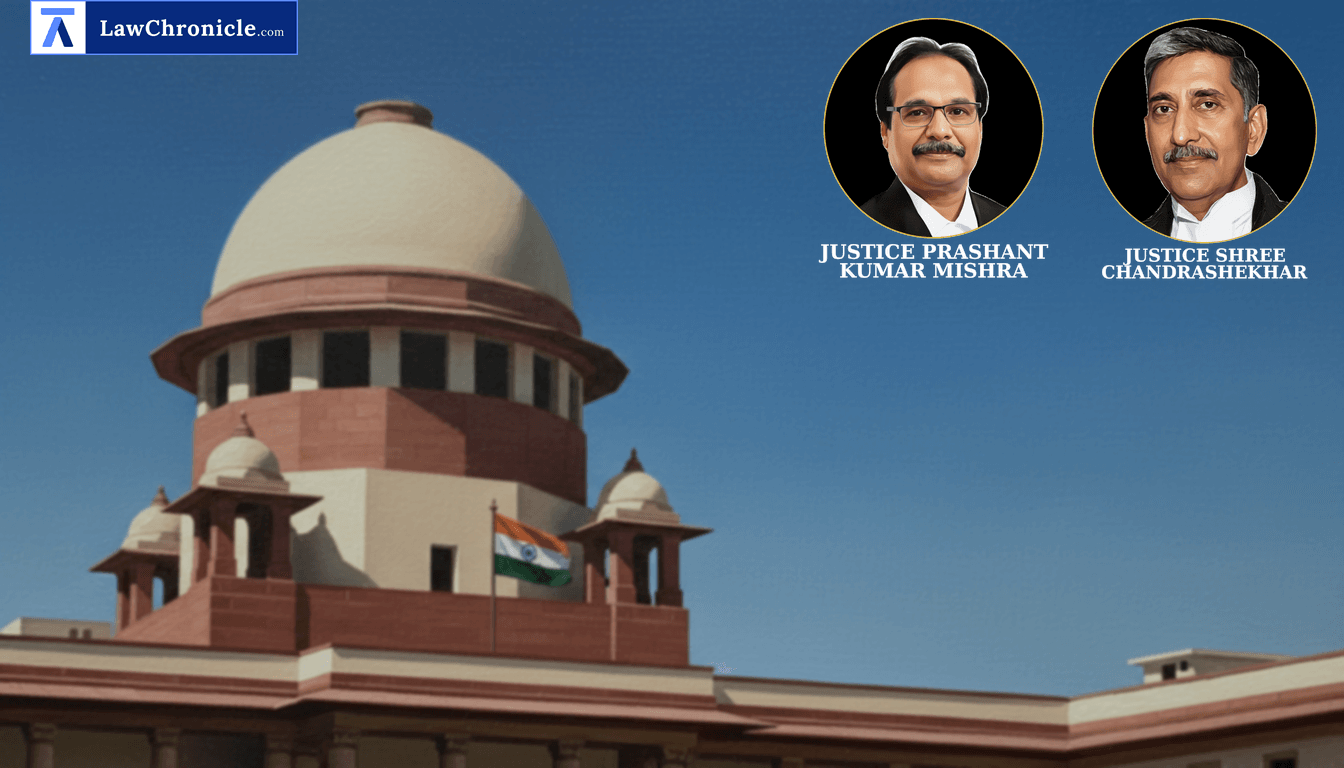
Invoking the doctrine of cognate offences, the Supreme Court has ruled that a charge of robbery cannot stand without the proof or recovery of stolen articles. Clarifying the application of Section 222 of the Code Of Criminal Procedure, 1973, the Apex Court converted a conviction to grievous hurt where physical injuries are proved..
In a benchmark criminal jurisprudence ruling, a Division Bench comprising Justice Prashant Kumar Mishra and Justice Shree Chandrashekhar considered an appeal challenging conviction under Section 394 of the Indian Penal Code, 1860. The legal issue centered on whether an accused could be held guilty of robbery when no stolen articles were recovered and no receipt or proof of ownership was produced, despite reliable witness identification and medical evidence establishing physical violence.
Key Takeaways
Doctrine of Cognate Offences Applied
Courts can convict an accused for a minor or less grave offence under Section 222 CrPC even if not separately charged, provided the essential facts of the minor offence are established.
Recovery of Stolen Articles
Without the recovery of alleged stolen goods or evidence linking seized property to the victim, a conviction for robbery under Section 394 IPC is legally unsustainable.
Identification Valid Without TIP
Absence of a Test Identification Parade is not fatal if the victim had prior acquaintance and adequate opportunity to identify the accused in proper light during an extended incident.
Robbery - Grievous Hurt
The Supreme Court modified the appellant's conviction from Section 394 IPC to Section 325 IPC, noting that while the robbery charge failed due to lack of physical evidence or recovery of jewellery, the causing of grievous hurt, specifically the dislocation of a tooth, was fully proved by witness testimony and medical corroboration.
The Apex Court observed that “Under Section 222 of the Code of Criminal Procedure, 1973 (corresponding to Section 245 of the Bharatiya Nagarik Suraksha Sanhita, 2023), a person charged with an offence consisting of several particulars may be convicted where the proved facts constitute a minor offence, notwithstanding that the minor offence was not separately charged. This Court in Rafiq Ahmed @ Rafi vs. State of U.P. had rightly described this as the principle of cognate offences, which enables Courts to convict and sentence offenders for a 'minor' or less grave offence whose essentials are satisfied by the evidence on record, even when the original charge was framed for the 'major' offence.” Addressing the quantum of sentence, the Court referred to Mathai vs. State of Kerala ( "2005 INSC 30": 2005 CaseBase(SC) 1016) to restrict the sentence to the period of custody already undergone.
Ratio
Where the essential component of robbery fails due to non-recovery of stolen property and lack of evidence connecting seized items to the victim, a major charge under Section 394 IPC cannot be sustained. However, by virtue of Section 222 of the Code Of Criminal Procedure, 1973 (Section 245 of Bharatiya Nagarik Suraksha Sanhita, 2023), the Court can convict the accused for the minor cognate offence of causing grievous hurt under Section 325 of the Indian Penal Code, 1860 if supported by evidence.
Background
The case stems from an incident on January 23, 1993, where four persons entered a farmhouse in Maharashtra. The complainant was threatened with a knife, punched in the face causing a tooth to fall out, and allegedly robbed of her gold mangalsutra and dorle. The Trial Court convicted the appellant under Section 394 of the Indian Penal Code, 1860 and sentenced him to seven years of rigorous imprisonment, which was later affirmed by the High Court of Judicature at Bombay.
Before the Supreme Court, the appellant contended that his identity was not established, as no Test Identification Parade was held. The Apex Court rejected this argument, noting the FIR was lodged within four hours, the incident lasted an hour under porch light, and the complainant had prior acquaintance with the appellant. However, on the charge of robbery, the Supreme Court noted there was no recovery of jewellery, no purchase receipt, and beads found at the scene were never connected to the stolen mangalsutra. Applying the precedent in Rafiq Ahmed @ Rafi vs. State of U.P. ( "2011 INSC 546": 2011 CaseBase(SC) 587), the Supreme Court modified the conviction to Section 325 Indian Penal Code, 1860 and reduced the sentence to the period already undergone (approx. 10 months).
Case Details:
Case No.: Criminal Appeal No. 4766 of 2026
Neutral Citation: 2026 INSC 1091
Case Title: Appa v. The State of Maharashtra
Source: 2026 CaseBase(SC) 8243
Similar Articles




 Breaking News


