

HM Seervai: The Lawyer who refused to become a Supreme Court Judge - Twice
 Copy Link
 Share
Share Save
Save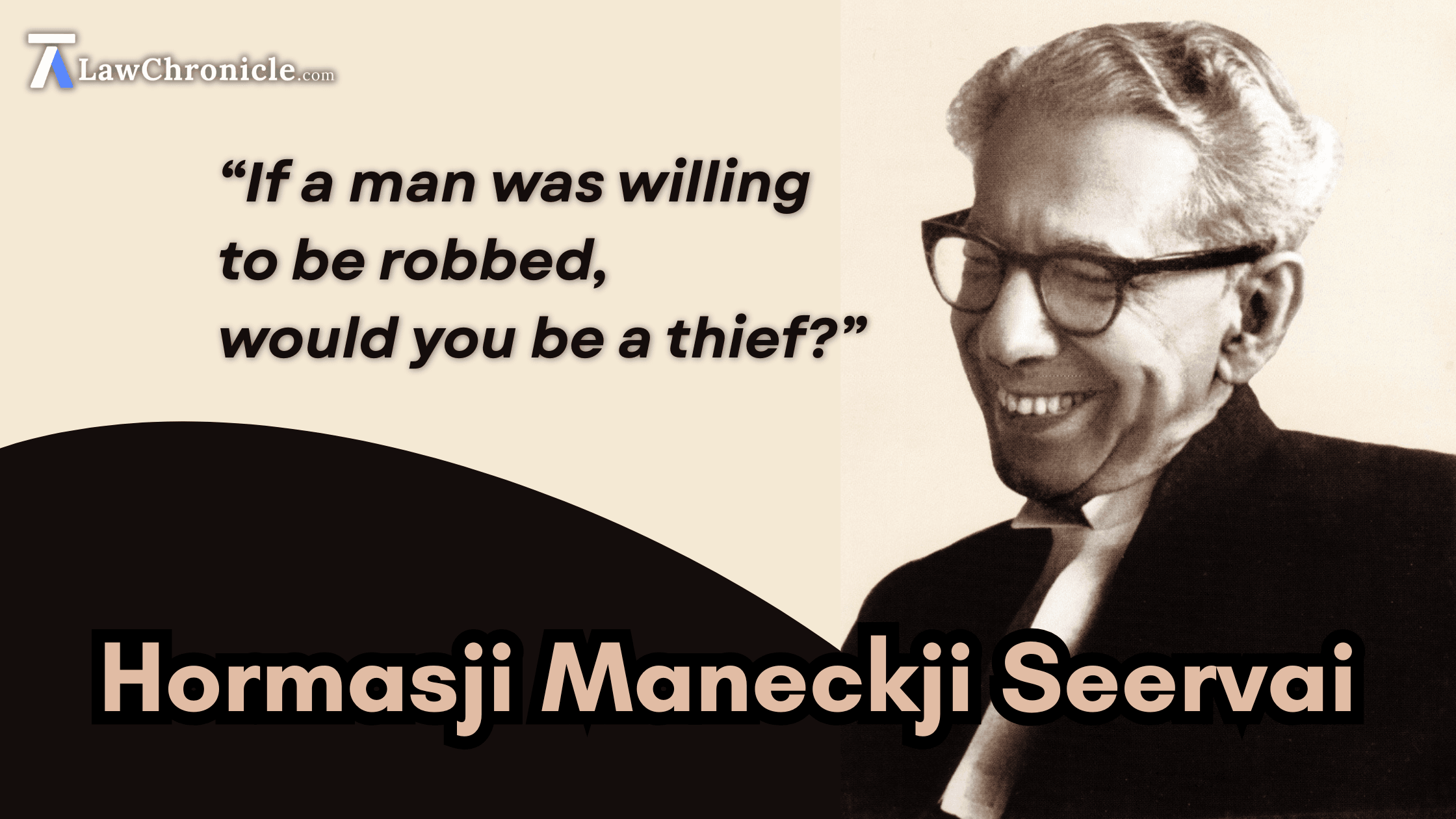
Hormasji Maneckji Seervai, widely known as HM Seervai, was one of India's most distinguished constitutional lawyers, Senior Advocates, jurists, and legal scholars. Born in Bombay (now Mumbai) into a middle-class Parsi family, he served as Advocate General of Bombay and subsequently of Maharashtra for an unparalleled span of seventeen years, from 1957 to 1974. He is internationally renowned as the author of “Constitutional Law of India: A Critical Commentary”, a monumental three-volume treatise that remains the foremost scholarly reference on the Indian Constitution and continues to be cited by the Supreme Court of India, High Courts across the country, and superior courts in other common law jurisdictions.
HM Seervai's contribution to Indian constitutional jurisprudence extended beyond the courtroom. His advocacy in landmark cases, most notably Kesavananda Bharati v. State of Kerala (1973 CaseBase(SC) 111), which gave birth to the basic structure doctrine, shaped the course of constitutional interpretation in India for generations. His fearless independence, extraordinary erudition, and unflinching commitment to the rule of law earned him the Padma Vibhushan in 1972, election as a Corresponding Fellow of the British Academy in 1981, and recognition as a Living Legend of Law by the International Bar Association in 1994.
In the words of Justice Michael Kirby of the High Court of Australia, who delivered the H.M. Seervai Memorial Lecture at the Bombay High Court: “He was the advocate’s advocate. He lived in tumultuous times for India. He was an example and an inspiration for lawyers and law students in India, and thus for all of us in the company of the common law scattered to every corner of the globe.”
Early Life and Education
Hormasji Maneckji Seervai was born on 5th December, 1906 in Bombay. He belonged to a middle-class Parsi family. According to Justice Kirby's account of Seervai's life, the name 'Seervai' is said to derive from Persian words meaning 'like a lion', an epithet that would prove apt for his career at the Bar. Although his father died when he was still a boy, Seervai's family, particularly his widowed mother, ensured his education with meticulous care.
Schooling
Seervai matriculated from Bhada New High School (also recorded as Bharda New High School), Mumbai. He thereafter joined the celebrated Elphinstone College, Bombay, in 1922.
Higher Education
In 1926, Seervai graduated from Elphinstone College with a First Class degree in Philosophy. He was a student of Professor J.C.P. D'Andrade, an illustrious teacher of logic and philosophy, as was his future wife Feroza. His philosophical training, emphasising rigorous logic, clarity of thought, and precision in argument, is widely regarded as foundational to the analytical sharpness he displayed throughout his legal career.
Legal Education
Seervai received his law degree from Government Law College, Mumbai. He was enrolled with the Bar in 1929.
Legal Career of HM Seervai
Enrolment and Early Practice
In 1932, at the age of 26, Seervai joined the Chambers of Sir Jamshedji Behramji Kanga, who had served as Advocate General of Bombay from 1923 to 1935. Seervai commenced practice on the Original Side of the Bombay High Court. His early years were marked by what he himself called a period of being 'semi-briefless', yet he never doubted his own capacity. He had an effortless command of the English language and its classics, and was described by contemporaries as quick, logical, and incisive.
By the early 1950s, Seervai was much in demand for briefs junior to the then Advocate General of Bombay. A notable early success came in the defence of the Bombay Prohibition Act. His first major appearance before the Supreme Court of India arose out of a defence of the Government of Bombay's decision to ban prize competitions in the nature of lotteries, a matter that reached the Supreme Court as The State of Bombay v. R.M.D. Chamarbaugwala [1957 CaseBase(SC) 51]. Seervai's argument succeeded spectacularly: the judgments and orders of the Bombay courts were unanimously set aside with costs.
Designation as Senior Advocate
Seervai attained recognition as a Senior Advocate, the highest designation conferred upon members of the Bar in India. He was widely regarded as possessing a profound knowledge of law spanning almost all branches of civil law, and was described by senior colleague Atul Setalvad as unique in that regard.
As Advocate General of Maharashtra (1957–1974)
In 1957, Seervai was appointed Advocate General of Bombay, and continued in office as Advocate General of Maharashtra after the reorganization of states in 1960. He held this office with signal distinction for seventeen years, the longest tenure of any Advocate General in the history of Maharashtra. Throughout this period, Seervai was conspicuous for his fearlessness and independence in the advice he tendered to government, his comparative indifference to the income and opportunities which the post offered, and his detachment from political considerations of the day.
In the words of Fali S. Nariman, a doyen of the Bombay Bar, Seervai discharged his duties as Advocate General guarding the law 'with erudition, fine advocacy and high integrity'. Justice R.S. Pathak recalled that he was 'extremely jealous of protecting [the courts'] public reputation, anxious to see that the stream of justice flowed unpolluted'.
Seervai resigned as Advocate General of Maharashtra in 1974 when the Law Minister appointed two advocates whom Seervai described as 'party lawyers' to advise him, a move he interpreted as undermining his constitutionally necessary independence. The resignation was widely regarded as a demonstration of the highest professional principle.
Declination of Judicial and Other Appointments
During his tenure as Advocate General, Seervai was offered several high constitutional offices and declined each. In 1971, the Government of India offered to appoint him as Attorney General for India. He declined, writing in his own hand to the Law Minister that the best contribution he could make to the law was not to appear in Court but to 'embody in successive editions of his book the correct judicial interpretation of the Constitution'. He was also offered judgeship of the Supreme Court of India on two occasions, and declined each time.
Areas of Specialization
Seervai's primary area of practice and scholarship was constitutional law, with particular emphasis on fundamental rights, constitutional interpretation, parliamentary sovereignty, federalism, judicial review, and the limits of legislative power. He also commanded expertise across virtually all branches of civil law.
Notable Clients and Institutions Represented
As Advocate General, Seervai appeared on behalf of the State of Maharashtra in matters before the Supreme Court of India and the Bombay High Court. He appeared in several of the most consequential constitutional cases heard by the Supreme Court, including those involving the Government of Bombay, the Union of India, and various State governments across India.
Notable Cases of Hormasji Maneckji Seervai
HM Seervai appeared in, or provided critical legal scholarship on, several of the most important constitutional matters in Indian legal history. The following cases represent the most significant of his professional contributions.
Kesavananda Bharati v. State of Kerala (1973 CaseBase(SC) 111)
Widely regarded as the most consequential constitutional case in Indian legal history, Kesavananda Bharati v. State of Kerala established the basic structure doctrine, the principle that Parliament, while endowed with the power to amend the Constitution under Article 368, cannot alter its 'basic structure'. The Supreme Court, sitting in a largest bench of thirteen judges, held by a majority of 7:6 that certain foundational features of the Constitution, including the supremacy of the Constitution, the separation of powers, the rule of law, judicial review, and fundamental rights, lie beyond Parliament's amending power.
HM Seervai's scholarship, particularly in his Constitutional Law of India, contributed significantly to the development of the arguments articulated in this case. The decision directly limited the scope of the 24th, 25th, and 29th Constitutional Amendments. The judgment remains the defining ruling on the relationship between parliamentary sovereignty and constitutional supremacy in India, and Seervai's analysis of it occupies an extensive portion of his treatise.
In Re: Keshav Singh (Parliamentary Privileges Case) (1964 CaseBase(SC) 270)
In this landmark matter concerning the interface between parliamentary privileges and judicial review, HM Seervai appeared for the Uttar Pradesh Legislature. The case raised fundamental questions about the extent of legislative privileges under Articles 105 and 194 of the Constitution, and whether courts could judicially review the exercise of such privileges. The Supreme Court, in an authoritative pronouncement, delineated the boundaries between parliamentary privilege and the rule of law, a seminal contribution to Indian constitutional doctrine.
The State of Bombay v. R.M.D. Chamarbaugwala (1957 CaseBase(SC) 51)
This was Seervai's first major success before the Supreme Court of India. The case concerned the validity of a Bombay government notification banning prize competitions in the nature of lotteries. Seervai appeared for the State of Bombay. The Supreme Court unanimously set aside the orders of the Bombay courts, vindicating Seervai's constitutional arguments and establishing him as a leading constitutional advocate.
R.C. Cooper v. Union of India (Bank Nationalisation Case) (1970 CaseBase(SC) 36)
The Bank Nationalisation Case arose from the Banking Companies (Acquisition and Transfer of Undertakings) Act, 1969, by which the Union Government nationalised fourteen major commercial banks. The Supreme Court, by a majority, struck down the legislation on the grounds that it violated the right to property and the right to equality. HM Seervai offered an incisive critique of the majority decision in successive editions of his Constitutional Law of India, which Justice Kirby described as a 'spirited attack' born of Seervai's deep commitment to constitutional doctrine.
Golak Nath v. State of Punjab (1967 CaseBase(SC) 162)
In Golak Nath v. State of Punjab, the Supreme Court held by a majority of six to five that Parliament had no power to amend the fundamental rights provisions of the Constitution. This ruling, later prospectively overruled in Kesavananda Bharati, was the subject of sustained and detailed critical analysis by Seervai in his treatise. He regarded the reasoning of the majority as doctrinally unsound, and his commentary formed an important part of the intellectual landscape in which subsequent constitutional adjudication developed.
A.D.M. Jabalpur v. Shivakant Shukla (The Habeas Corpus Case) (1976 CaseBase(SC) 382)
During the period of the Emergency declared by Prime Minister Indira Gandhi in 1975, the Supreme Court of India held in A.D.M. Jabalpur v. Shivakant Shukla that the right to move any court for enforcement of the right to life and personal liberty under Article 21 stood suspended during the Emergency. Seervai was foremost in his condemnation of this ruling, widely regarded as one of the lowest moments in Indian judicial history. His book Emergency, Future Safeguards and the Habeas Corpus Case (1976 CaseBase(SC) 382) is a sustained critical analysis of the case and its constitutional implications, and a powerful defence of civil liberties.
The Unsparing Commentary on Impeachement
Seervai and the Attempted Impeachment of Justice V. Ramaswami
In the preface to the fourth edition of his Constitutional Law of India, Seervai devoted four closely printed pages to a critical commentary on the attempted impeachment of Justice V. Ramaswami, a judge of the Supreme Court of India, the first such proceeding in Indian constitutional history. The matter arose following adverse findings by a three-judge inquiry committee appointed under the Judges (Inquiry) Act, 1968.
Seervai's commentary was characteristically direct and unsparing. As Justice Kirby observed in his 2009 lecture, 'the affront to his sensibilities is plain'. Seervai's treatment of this episode illustrates both his unwavering commitment to judicial accountability and his view that the constitutional process governing removal of judges must be conducted with absolute fidelity to principle. His commentary remains an important scholarly reference on the constitutional provisions relating to judicial accountability under Articles 124 and 218.
Public Positions and Legal Philosophy
Constitutional Interpretation
Seervai was a committed exponent of what may be described as the orthodox or textual approach to constitutional interpretation. He was deeply influenced by the principles he associated with great English judges, particularly Lord Reid and Lord Denning, and was wary of the importation of political, economic, or social considerations into constitutional adjudication. He drew frequently on the authority of Dr Anstey Wynes's critical commentary on the Australian Constitution, which had inspired him to undertake his own work.
In the preface to the first edition of his treatise, Seervai set out his guiding principle: to separate the statement of the law from his own submissions on it. He was nonetheless willing to express his views with candour and, where necessary, with severity. As he wrote: 'The cause I serve is that of a correct and coherent interpretation of our Constitution. If any of my criticisms are found to be correct, the cause is served; and if any are found to be incorrect the very process of finding out my mistakes may lead to the discovery of the right reasons, or better reasons, than I have been able to give, and the cause is served just as well.'
Civil Liberties and the Emergency
Seervai took up the cause of civil liberties as President of the People's Union for Civil Liberties (PUCL) and often spoke on public platforms in their support. His book Emergency, Future Safeguards and the Habeas Corpus Case (1976 CaseBase(SC) 382) stands as a landmark in Indian civil liberties scholarship. He was foremost in condemning the weakness of the courts during the Emergency of 1975-77, and his analysis of the Habeas Corpus case and the Liversidge v. Anderson precedent from England gave scholarly foundation to the movement for constitutional reform in the post-Emergency period.
The Basic Structure Doctrine
Although Seervai was initially disposed against the basic structure doctrine as articulated in Kesavananda Bharati, a position he held on grounds of constitutional text and doctrine, he came, in time, to appreciate its importance as a safeguard for the foundations of democratic government in India, particularly in light of the experience of the Emergency. His willingness to revise his position in the face of constitutional experience illustrated the practical wisdom that lay beneath his often polemical exterior.
On the Partition of India
In Partition of India: Legend and Reality (1989), Seervai offered a revisionist account of the Partition, arguing that it was not simply the result of the intransigence of Muhammad Ali Jinnah and the Muslim League but was substantially attributable to the Congress leadership's refusal to accommodate Muslim political interests and to accept parity of power-sharing. He argued that the 'crime' of mixing religion and politics was shared by all parties, including the Congress leadership. This work generated considerable academic debate and remains a significant contribution to the historiography of Partition.
Publications
HM Seervai was a prolific author whose published works span constitutional law, civil liberties, and modern Indian history. The following represent his principal publications:
HM Seervai Books
Constitutional Law of India: A Critical Commentary (1967; 4th Edition, 3 Volumes, 1991–96)
First published in 1967, this three-volume treatise is Seervai's magnum opus and the most authoritative scholarly work on the Indian Constitution in existence. The fourth edition, a Silver Jubilee Edition, was completed by Seervai in the final hours of his life and published posthumously, running to over 3,250 pages. The work is opinionative, analytical, and at times sharply critical of judicial decisions it regards as doctrinally erroneous. It has been elected as a Corresponding Fellow distinction by the British Academy and cited by superior courts in India, Australia, and other common law jurisdictions.
Lord Mackay of Clashfern described it as 'a permanent memorial to his massive erudition' and 'not a mere commentary of the usual kind'. The Supreme Court of India has cited it extensively across numerous benches and contexts, including constitutional interpretation, administrative law, tax law, and federalism.
Emergency, Future Safeguards and the Habeas Corpus Case: A Criticism (1978)
This work, published in the aftermath of the Emergency of 1975–77, is a critical examination of the Supreme Court's decision in A.D.M. Jabalpur v. Shivakant Shukla (1976) and its implications for civil liberties in India. Seervai analyses the constitutional basis of the Emergency, the suspension of fundamental rights, and the failure of the courts to protect the right to personal liberty. He draws on comparative material, including the English wartime decision in Liversidge v. Anderson [1942] AC 206, to illustrate the dangers of judicial abdication in times of executive excess.
Partition of India: Legend and Reality (1989)
A controversial and meticulously researched historical work, this volume challenges the conventional historiography of the Partition of India, arguing that the Congress leadership, and not Jinnah alone, bore substantial responsibility for the division of the subcontinent. Seervai draws extensively on the Transfer of Power Papers and other archival sources. The work has been included as an appendix to the fourth edition of Constitutional Law of India.
The Position of the Judiciary Under the Constitution of India
A shorter but significant work examining the constitutional and institutional foundations of judicial independence in India.
The Seervai Legacy: Essays, Speeches, Tributes, Letters (2nd Edition, Reprint)
A commemorative volume containing essays, tributes, and correspondence relating to Seervai's life and contributions to Indian law, published by Law & Justice Publishing Company.
Awards and Recognition
- Padma Vibhushan (1972): Conferred by the Government of India, the second-highest civilian honour in the country, in recognition of Seervai's exceptional contribution to Indian constitutional law and his treatise on the Constitution.
- Corresponding Fellow, The British Academy (1981): Elected by the British Academy, a distinction reserved for scholars of the highest academic standing outside the United Kingdom. This honour recognised Seervai's constitutional treatise as a work of international scholarly significance.
- Dadabhai Naoroji Prize (1981): Awarded in recognition of his outstanding contributions to legal scholarship.
- Honorary Fellow, Asiatic Society of Bombay (1982): Elected in recognition of his scholarly and intellectual contributions.
- Living Legend of Law Award of Recognition - International Bar Association (1994): Awarded at the International Bar Association conference in recognition of Seervai's lifetime of contributions to the law.
- In addition, Lord Denning, described by many as the doyen of all judges, said of Seervai: 'He was a great personality and one of the most learned I have met.'
Personal Life of HM Seervai
HM Seervai married Feroza Seervai, who had been a fellow student of Professor J.C.P. D'Andrade at Elphinstone College. Feroza was a devoted companion throughout his scholarly career. She played an important role in the completion of the fourth edition of Constitutional Law of India. They had three children: Meher, Shirin, and Navroz, who became committed guardians of their father's legacy.
Seervai lived at home with his widowed mother until he was nearly forty. His family described him as a man of personal warmth, a brilliant memory for cricket scores and historical detail, and a voracious reader of the poets and historians from Thucydides to Churchill and Kipling. He was modest and frugal in personal expenditure, single-minded in his professional work, and deeply attached to his home in Mumbai, a preference that reportedly contributed to his declinations of judicial appointment.
Hormasji Maneckji Seervai passed away on 26th January, 1996 fittingly, on Republic Day of India. The fourth edition of his constitutional treatise was completed in the final hours of his life, as if his dedication to the Constitution had sustained him to the very last.
 Breaking News